How to Balance Green and Brown Materials in Compost
You pile up kitchen scraps and grass clippings, wait a few weeks, and instead of crumbly black gold you get a slimy, foul-smelling mess. The problem is almost never the compost bin itself—it is the ratio of green to brown materials inside it. Getting that balance right is the single most important skill in composting, and it determines whether your pile breaks down in weeks or sits stagnant for months. If you are working with a tumbler or another enclosed system and want to understand how airflow, moisture, and material balance work together, this guide on Click here covers the practical side of managing that type of unit. Below, you will find the exact ratio to aim for, how to fix a pile that has gone wrong, and why the “ideal” numbers are less rigid than most guides suggest.
Quick Answer
Aim for roughly two to three parts brown material to one part green material by volume. Browns are dry, carbon-rich items like dead leaves, cardboard, and straw. Greens are moist, nitrogen-rich items like grass clippings, food scraps, and coffee grounds. The goal is a pile that feels like a wrung-out sponge and smells earthy, not sour. If it smells bad or looks slimy, add more browns; if it is bone dry and nothing is breaking down, add more greens and moisture.
Key Takeaways
- The practical target is about 2–3 parts browns to 1 part greens by volume, not by weight.
- Browns supply carbon and structure; greens supply nitrogen and moisture. Both are needed for microbial breakdown.
- Smell and texture are faster diagnostic tools than any measurement—sour or slimy means too many greens, dry and inert means too few.
- Particle size matters as much as ratio; shredded or chopped material composts far faster than whole items.
- You can correct a struggling pile at any stage by adding the missing material and turning it.
What Counts as Green and What Counts as Brown
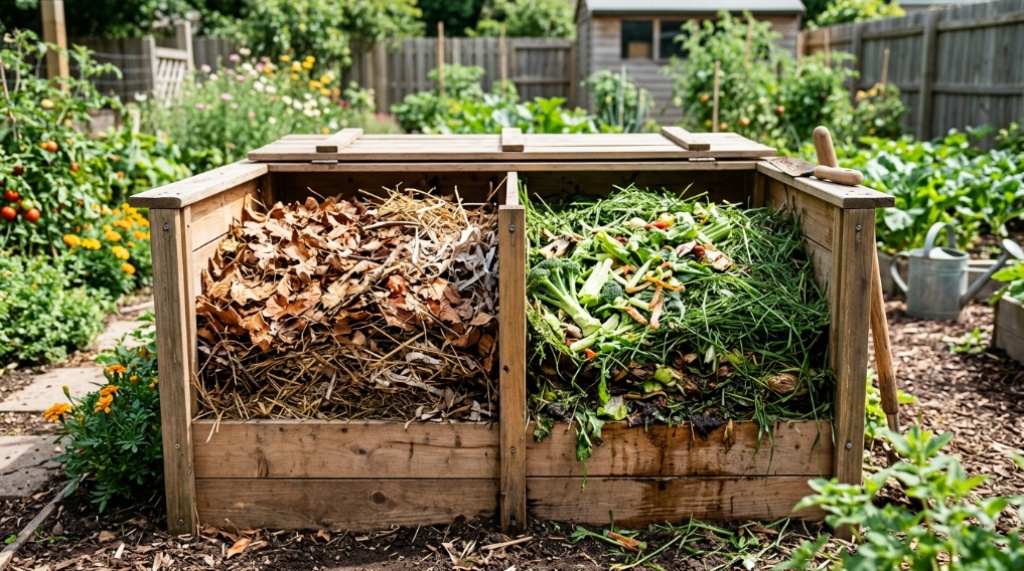
The green/brown distinction is really a shorthand for nitrogen content versus carbon content. Greens are the materials that rot quickly and release nitrogen, which feeds the microorganisms doing the work. Browns are the dry, fibrous materials that provide carbon for energy and create air pockets that keep the pile oxygenated.
Common greens include grass clippings, fruit and vegetable scraps, coffee grounds and filters, tea leaves, fresh plant trimmings, and manure from herbivores. Common browns include fallen leaves, shredded newspaper and cardboard, straw, hay, wood chips, sawdust, dried plant stems, and egg cartons.
Two items regularly confuse people. Coffee grounds are a green despite being brown in color, because they are high in nitrogen. And dryer lint or shredded paper count as browns even though they look neutral. Color is not a reliable guide; moisture and texture are better indicators. Greens tend to be wet and fresh, browns tend to be dry and brittle, If you are also looking to refresh your wardrobe while working on your garden projects, check out this guide on Style Olive Green Pants.
Why the 2:1 or 3:1 Ratio Works
Compost microorganisms need carbon for energy and nitrogen for building proteins and reproducing. When the carbon-to-nitrogen ratio is roughly in the range of 25:1 to 30:1, they work efficiently. Since browns have a much higher carbon ratio than greens, combining them at about two to three parts browns to one part greens by volume tends to land in that working range.
That said, the “ideal” ratio is a target, not a rule. Different browns and greens have different carbon-to-nitrogen profiles—sawdust is far more carbon-dense than shredded leaves, and manure is far more nitrogen-rich than vegetable peels. Treat the ratio as a starting point you adjust based on how the pile behaves.
How to Tell If Your Pile Is Out of Balance
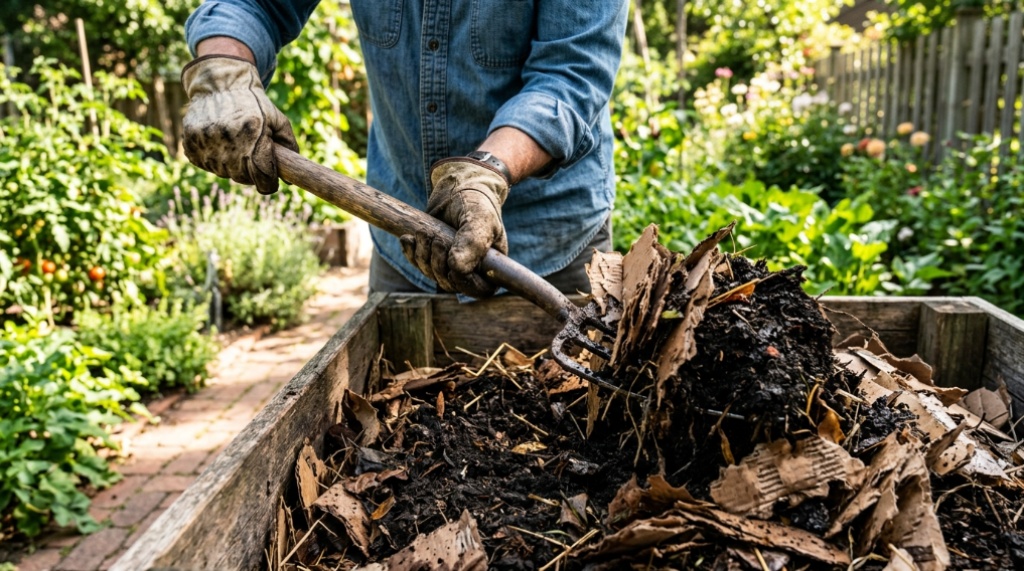
Your nose and hands will usually tell you what the pile needs before any calculation will.
- Too many greens: Sour, ammonia-like, or rotting smell. Slimy, wet texture. Pile heats up fast then collapses or mats down. Solution: add browns and turn.
- Too many browns: Nothing seems to be happening. Pile stays cool and dry. Materials look the same weeks later. Solution: add greens, add water, and turn.
- Balanced: Mild earthy smell, like forest floor. Slightly damp, not dripping. Pile warms up within a day or two of turning. Volume shrinks steadily.
If you only remember one rule, remember this: add browns until the smell goes away. That single correction fixes the majority of compost problems.
Ratio by Volume, Not Weight
This trips up many beginners. Browns like leaves and cardboard are lightweight and bulky; greens like grass clippings and food scraps are heavy and dense. If you measure by weight, you will badly under-add browns. Measure by volume—think in terms of how much space each material takes up in the bin, not how much it weighs on a scale.
A useful visual shortcut: for every bucket of kitchen scraps, add two to three buckets of shredded leaves or cardboard. It looks like a lot of browns, and that is exactly right.
| Material | Category | Notes |
|---|---|---|
| Grass clippings | Green | Very nitrogen-rich; add in thin layers to avoid matting |
| Coffee grounds | Green | High nitrogen despite brown color |
| Fruit and vegetable scraps | Green | Chop smaller for faster breakdown |
| Fresh plant trimmings | Green | Avoid diseased or seeded plants |
| Fallen leaves | Brown | Shred for faster decomposition |
| Cardboard and newspaper | Brown | Tear or shred; avoid glossy or waxed coatings |
| Straw and hay | Brown | Excellent structure; chop for smaller piles |
| Sawdust and wood chips | Brown | Very carbon-dense; use sparingly |
Step-by-Step: Building a Balanced Pile
- Start with a layer of coarse browns at the bottom—twigs, straw, or wood chips—to allow airflow.
- Add a layer of greens, roughly one-third the volume of the browns you plan to use.
- Add two to three parts browns on top, shredding or tearing larger pieces as you go.
- Repeat the layering as you add material over time, alternating greens and browns rather than dumping everything in one spot.
- Turn the pile every one to two weeks to mix materials and reintroduce oxygen.
- Check moisture each time you turn. Add water if dry, add browns if soggy.
- Adjust continuously based on smell and texture rather than trying to hit an exact number once.
Common Mistakes That Throw Off the Balance
Even experienced composters fall into a few predictable traps.
- Adding grass clippings in thick mats. Clippings compact into an oxygen-free layer that turns anaerobic and smells foul. Mix them in or let them dry first.
- Ignoring particle size. Whole leaves and large cardboard sheets break down slowly and create uneven pockets. Shred or chop everything you reasonably can.
- Neglecting moisture. A perfectly balanced pile that is bone dry will not compost. Aim for the consistency of a wrung-out sponge.
- Overloading with one brown type. Sawdust alone, for example, is so carbon-heavy that it can stall a pile for months. Mix brown sources.
- Never turning. Even a well-ratioed pile needs oxygen. Turning is what converts a slow pile into a fast one.
Adjusting an Existing Pile
You do not need to start over. If your pile smells sour, add a generous layer of shredded browns and turn it thoroughly. If it is dry and inactive, add greens, sprinkle water, and turn. Expect to do this more than once—corrections take a few days to show results.
For very wet or compacted piles, breaking the pile apart completely and rebuilding it in layers is sometimes faster than trying to fix it in place. This is especially true if the pile has been sitting for weeks without being turned.
One practical consideration for enclosed systems: tumblers and sealed bins limit how much airflow reaches the material, so getting the ratio and moisture right becomes even more important. Overloading a tumbler with wet greens is one of the most common reasons these units fail to produce compost.
Frequently Asked Questions
Can I compost without balancing greens and browns?
You can, but it usually produces a slow, smelly, or incomplete result. Balancing is what allows the pile to heat up, break down evenly, and finish in a reasonable timeframe.
Is it OK to add more browns than the ratio suggests?
Yes, and it is safer to err on the side of too many browns than too many greens. Browns are slower to cause problems; excess greens create odor and slime quickly. If the pile stalls from too many browns, just add greens and moisture.
How long does it take to fix an out-of-balance pile?
Usually one to two weeks after correction, assuming you turn the pile and adjust moisture. Very wet or compacted piles may take longer or need to be rebuilt.
Do I need to layer greens and browns, or can I just mix everything?
Either works. Layering is convenient for building a pile, but thorough mixing is generally better in the long run because it distributes materials evenly and prevents pockets of imbalance.
Should I add soil or compost starter?
Not strictly necessary. A small amount of finished compost or garden soil can introduce microorganisms, but a well-balanced pile with adequate moisture and oxygen will develop its own active microbial community.
What is the easiest way to remember the ratio?
Think “two or three browns for every green.” If you are unsure, add more browns—they are the forgiving side of the equation.
Conclusion
Balancing greens and browns is less about hitting an exact number and more about reading your pile. Add two to three parts browns for every part greens by volume, keep the moisture at the wrung-out-sponge stage, turn regularly, and adjust based on smell and texture. If the pile smells sour, add browns. If it is dry and idle, add greens and water. That simple feedback loop will get you finished compost faster than any formula, and it works whether you are using an open bin, a pile in the corner of the yard, or an enclosed tumbler.