
How to Install a Protein Skimmer in a Saltwater Aquarium Properly
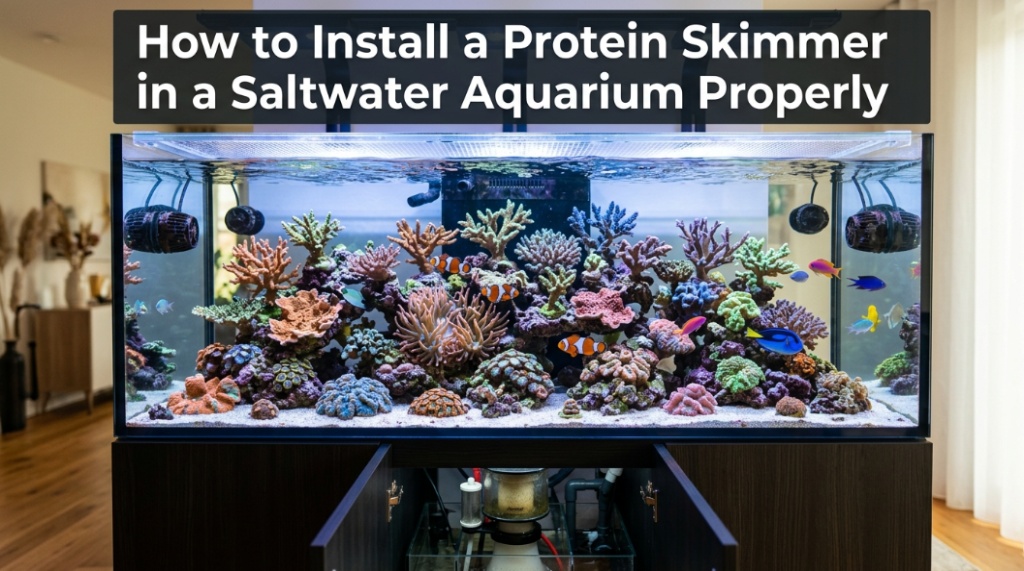
Most reef tank crashes do not begin with dead fish. They begin silently with invisible dissolved organic waste building up in water that still looks crystal clear. That is exactly why understanding how to install protein skimmer systems properly matters more than most beginners realize. A correctly installed protein skimmer removes proteins, oils, and organic compounds before they break down into ammonia and nitrate. Poor installation, however, can cause microbubbles, unstable foam production, noisy overflow, and weak nutrient export.
What Is a Protein Skimmer and Why Is Proper Installation Important?
A protein skimmer is a filtration device that removes dissolved organic compounds from saltwater before they decompose into harmful waste. Proper installation improves water quality, oxygen exchange, nutrient control, and overall reef aquarium stability.
Protein skimmers use foam fractionation. Tiny air bubbles attract waste particles, proteins, and oils. These compounds rise into a collection cup where they can be removed from the aquarium system. This process reduces nitrate buildup, phosphate accumulation, and algae growth.
According to marine aquarium maintenance data shared by reef hobby communities and aquarium equipment manufacturers, protein skimmers can significantly reduce dissolved organic waste in reef systems when sized and installed correctly.
Improper setup creates several problems:
- Wet overflowing foam
- Microbubbles inside display tank
- Weak skimmate production
- Excessive noise
- Unstable water levels
- Reduced oxygenation
For reef aquariums containing coral, clownfish, tangs, gobies, and invertebrates, efficient protein skimming becomes a major part of long-term biological stability.
How Does a Protein Skimmer Work in a Saltwater Aquarium?
A protein skimmer works by injecting fine air bubbles into saltwater so organic waste attaches to bubble surfaces and rises into a collection cup for removal.
This process is called foam fractionation. Saltwater naturally supports stable bubble formation better than freshwater, which is why protein skimmers are mainly used in marine aquariums.
Here is the basic process:
| Step | What Happens |
|---|---|
| Air Injection | Pump creates thousands of microbubbles |
| Waste Attraction | Proteins and dissolved organics attach to bubbles |
| Foam Rise | Bubbles move upward into skimmer neck |
| Collection | Waste foam gathers inside collection cup |
| Removal | Dirty skimmate is emptied manually |
Modern reef tank skimmers commonly use:
- Needle-wheel impellers
- Venturi air injection
- DC controllable pumps
- Cone-shaped reaction chambers
- Bubble diffusion plates
These technologies improve contact time between air and water, increasing waste removal efficiency.
What Tools and Equipment Do You Need Before Installing a Protein Skimmer?
You need the correct skimmer type, stable sump conditions, manufacturer recommendations, and proper water depth before installation begins.
Preparation prevents most beginner setup issues. Before installation, gather these essentials:
- Protein skimmer unit
- Sump or aquarium chamber
- Stable power outlet
- RODI saltwater system
- Aquarium towel
- Measuring tape
- Skimmer stand if needed
- Airline tubing
- Water level marker
What Water Depth Should a Protein Skimmer Sit In?
Most protein skimmers perform best between 7 and 9 inches of water depth, though exact requirements vary by manufacturer.
Always check the manual. Incorrect water depth is one of the biggest causes of inconsistent foam production.
If water depth is too high:
- Skimmer may overflow
- Foam becomes excessively wet
- Collection cup fills rapidly
If water depth is too low:
- Bubble production weakens
- Foam head collapses
- Organic waste removal decreases
Many reef keepers use acrylic skimmer stands to achieve precise operating depth.
How to Install Protein Skimmer Step by Step?
To install a protein skimmer properly, place it in stable water depth, connect pump and airline tubing, adjust water flow, and allow a break-in period before fine tuning.
Step 1: Choose the Correct Placement Area
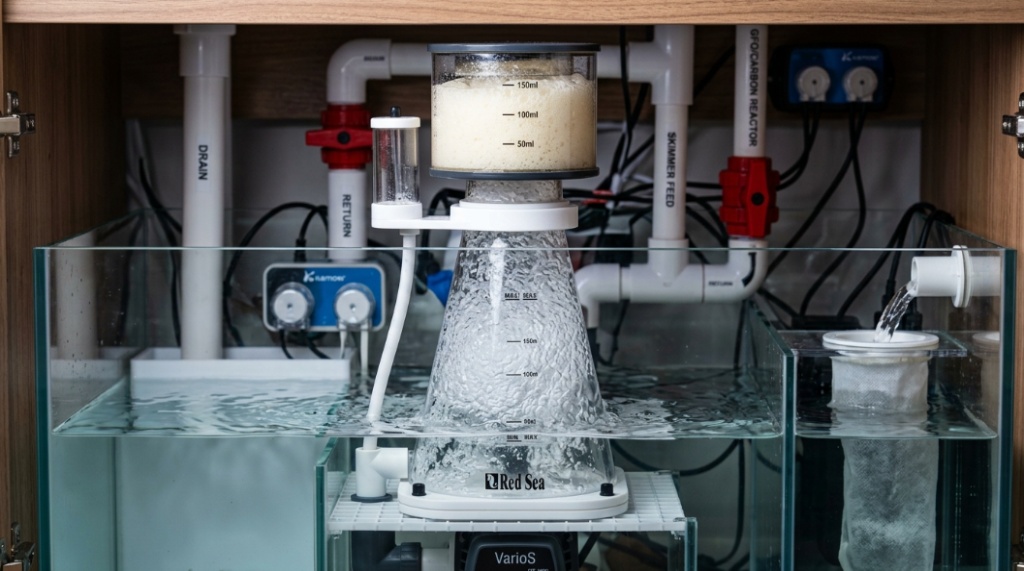
Place the protein skimmer in the sump chamber where water level remains constant.
Most reef aquarium sumps contain multiple compartments:
- Drain section
- Skimmer chamber
- Refugium
- Return pump chamber
The skimmer chamber is usually the best location because it maintains stable water height.
If you are using a hang-on-back protein skimmer, install it on the rear wall of the aquarium with enough clearance for maintenance access.
Step 2: Check Recommended Water Height
Verify water depth using the manufacturer recommendation before turning the skimmer on.
Use a measuring tape or ruler. If needed, add a skimmer riser platform.
Stable water height is critical because evaporation changes skimmer performance dramatically. Many reef aquarists use auto top-off systems to maintain consistency.
Step 3: Assemble the Protein Skimmer
Assemble all skimmer components securely before operation.
Most skimmers include:
- Reaction chamber
- Collection cup
- Pump
- Bubble plate
- Air silencer
- Airline tubing
Inspect every gasket and O-ring carefully. Loose fittings often create leaks or airflow problems.
Step 4: Connect Airline Tubing Properly
Attach airline tubing securely to the venturi intake or air silencer.
Restricted airflow reduces skimmer efficiency significantly. Ensure tubing:
- Is not kinked
- Is not submerged
- Has unobstructed airflow
- Remains dry externally
Salt creep buildup inside airline tubing can eventually reduce performance, so periodic cleaning is important.
Step 5: Turn On the Skimmer
Power on the protein skimmer and monitor initial bubble production.
New skimmers often behave unpredictably during the first few days. Common startup behavior includes:
- Overflowing foam
- Large unstable bubbles
- Noise fluctuations
- Minimal skimmate production
This is normal during the break-in period.
Step 6: Adjust Water Flow and Foam Level
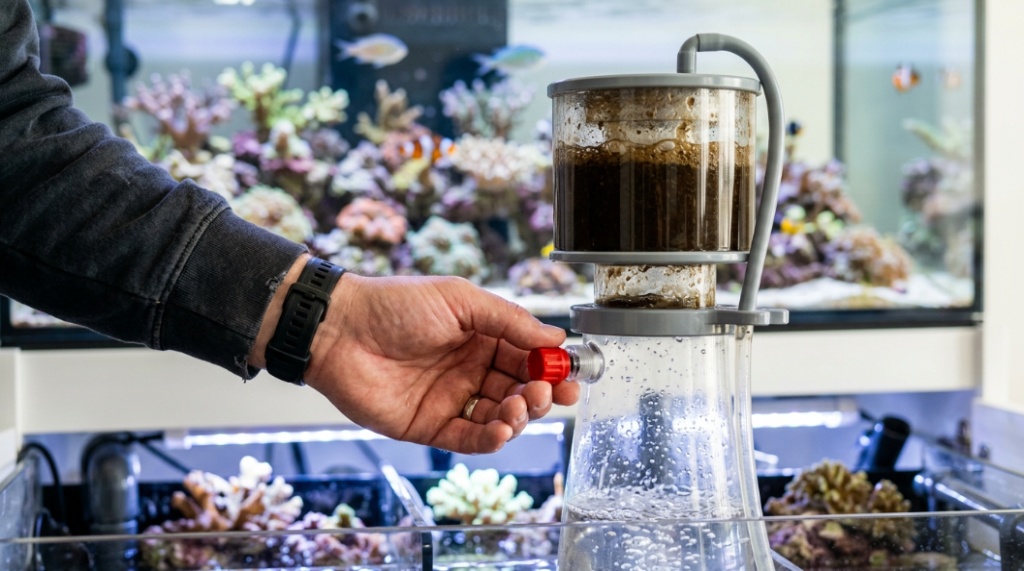
Adjust the skimmer output valve gradually until foam rises consistently into the neck.
A properly tuned skimmer creates a stable foam head.
Dry skimming produces:
- Darker skimmate
- Slower waste collection
- Better nutrient concentration removal
Wet skimming produces:
- Lighter skimmate
- Faster collection
- More water removal
Most reef keepers prefer moderate dry skimming for stable reef nutrient management.
How Long Does a Protein Skimmer Take to Break In?
Most protein skimmers require 3 to 7 days to complete the break-in period and stabilize foam production.
Manufacturing oils inside acrylic and pumps temporarily affect foam formation. During break-in, performance may fluctuate.
Several factors influence break-in duration:
- Tank bioload
- Water chemistry
- Skimmer brand
- Additives used
- Hands placed inside aquarium
Many aquarium products disrupt skimmer performance temporarily, including:
- Water conditioners
- Coral foods
- Epoxy adhesives
- Medication
- Bacterial supplements
Do not aggressively adjust settings during the first 48 hours unless severe overflow occurs.
What Is the Best Location for a Protein Skimmer?
The best location for a protein skimmer is a sump chamber with stable water height and high nutrient-rich water flow.
Placement directly affects skimmer efficiency. Ideally, the skimmer should process water before it reaches biological filtration media.
Best Placement Priorities
- Stable water level
- Consistent flow rate
- Easy maintenance access
- Minimal microbubble spread
- Good ventilation
Should a Protein Skimmer Run Before or After Refugium?
Most reef aquarists place the protein skimmer before the refugium to remove excess organic waste before macroalgae filtration.
This arrangement helps reduce nutrient overload while still allowing refugiums to process remaining nitrate and phosphate.
What Are Common Protein Skimmer Installation Mistakes?
The most common installation mistakes include unstable water level, incorrect adjustment, poor airflow, oversized skimmers, and improper cleaning.
Many beginners assume expensive equipment guarantees performance. Installation quality matters just as much.
Common Mistakes to Avoid
| Mistake | Result |
|---|---|
| Wrong water depth | Overflow or weak foam |
| Oversized skimmer | Inconsistent skimming |
| No break-in patience | Constant adjustment problems |
| Dirty air intake | Reduced efficiency |
| Unstable sump level | Erratic foam production |
| Ignoring maintenance | Performance decline |
Can a Protein Skimmer Be Too Big?
Yes. An oversized protein skimmer may struggle to create stable foam in lightly stocked aquariums.
If organic waste concentration is too low, the skimmer cannot maintain a consistent foam head. Matching skimmer capacity to actual aquarium bioload is more effective than simply buying the largest model available.
How Do You Tune a Protein Skimmer Correctly?
To tune a protein skimmer correctly, adjust internal water level slowly until stable foam forms near the collection neck.
Proper tuning depends on observation and patience.
Signs of Proper Tuning
- Stable foam column
- Dark tea-colored skimmate
- Minimal overflow
- Consistent bubble size
- Reduced aquarium odor
Signs of Incorrect Tuning
- Constant overflowing
- No foam production
- Excessive microbubbles
- Very watery skimmate
- Loud suction noise
Experienced reef keepers often wait several hours between adjustments because even small changes take time to stabilize.
How Often Should You Clean a Protein Skimmer?
Protein skimmer collection cups should usually be cleaned every 3 to 7 days for optimal performance.
Organic buildup inside the neck reduces foam efficiency over time.
Maintenance Schedule
- Collection cup: every 3–7 days
- Airline tubing: monthly
- Pump cleaning: every 2–3 months
- Full skimmer disassembly: every 3–6 months
Calcium buildup, salt creep, and biofilm accumulation gradually reduce airflow and pump efficiency.
Routine maintenance improves:
- Bubble consistency
- Waste removal
- Pump lifespan
- Noise reduction
- Energy efficiency
Do You Need a Protein Skimmer for Every Saltwater Aquarium?
No, but protein skimmers are highly recommended for most reef aquariums and heavily stocked marine systems.
Some nano aquariums rely on:
- Frequent water changes
- Macroalgae filtration
- Live rock biological filtration
- Low bioload stocking
However, protein skimmers provide major advantages:
- Better oxygen exchange
- Reduced nutrient buildup
- Improved water clarity
- Lower nitrate accumulation
- Cleaner reef environment
For SPS coral systems, mixed reefs, and heavily fed fish tanks, protein skimmers are often considered essential equipment.
What Size Protein Skimmer Should You Choose?
Choose a protein skimmer rated slightly above your aquarium’s actual water volume and bioload.
Manufacturers often advertise optimistic capacity ratings. Real-world performance depends heavily on stocking level.
General Sizing Recommendations
| Aquarium Type | Recommended Skimmer Rating |
|---|---|
| Light Bioload | Match actual water volume |
| Moderate Reef | 1.25x water volume |
| Heavy Bioload | 1.5x water volume |
Example:
A 75-gallon reef aquarium with tangs and heavy coral feeding may benefit from a skimmer rated for 100–120 gallons rather than exactly 75 gallons.
Can You Install a Protein Skimmer Without a Sump?
Yes. Hang-on-back protein skimmers allow installation without a sump.
HOB skimmers are popular for:
- Nano reef tanks
- Beginner marine aquariums
- Small saltwater systems
- Space-limited setups
However, sump-based skimmers usually provide:
- Better performance
- Quieter operation
- Higher water volume support
- Cleaner appearance
- Easier equipment integration
Conclusion
Learning how to install protein skimmer systems properly is one of the most important steps in building a stable saltwater aquarium. Correct installation improves nutrient export, oxygenation, water clarity, and long-term reef health. Most skimmer problems come from incorrect water depth, rushed adjustments, poor maintenance, or unstable sump conditions rather than defective equipment.
A properly tuned protein skimmer quietly removes dissolved organic waste before it becomes nitrate and phosphate. That means healthier coral, cleaner water, fewer algae outbreaks, and more stable marine livestock conditions.
Focus on stable water level, correct placement, gradual tuning, and consistent maintenance. Allow time for the break-in period before making major adjustments. Whether you run a nano reef aquarium or a large SPS coral system, a correctly installed skimmer becomes one of the most effective filtration tools available.
If you are building or upgrading a saltwater aquarium, use this guide as a setup checklist and maintenance reference to keep your marine ecosystem healthier for years.
FAQ: How to Install Protein Skimmer
How high should bubbles rise inside a protein skimmer?
Bubbles should rise steadily into the skimmer neck without overflowing aggressively into the collection cup. Stable foam formation indicates proper tuning.
Why is my new protein skimmer overflowing?
New protein skimmers often overflow during the break-in period because manufacturing oils affect foam production. Incorrect water depth can also cause overflow.
Should a protein skimmer run all the time?
Yes. Most saltwater aquarium protein skimmers should operate continuously for stable nutrient export and oxygen exchange.
Can a protein skimmer remove beneficial bacteria?
Protein skimmers mainly remove dissolved organic waste, not established biological filtration bacteria attached to rock and media surfaces.
How do I stop microbubbles from entering my display tank?
Check water depth, skimmer placement, bubble trap design, and break-in status. Microbubbles usually decrease after stabilization.
Do fish-only saltwater tanks need protein skimmers?
Fish-only marine aquariums benefit greatly from protein skimmers because fish produce significant organic waste and require strong oxygenation.
What color should protein skimmer waste be?
Healthy skimmate is usually dark brown, greenish-brown, or tea-colored depending on tuning style and aquarium bioload.